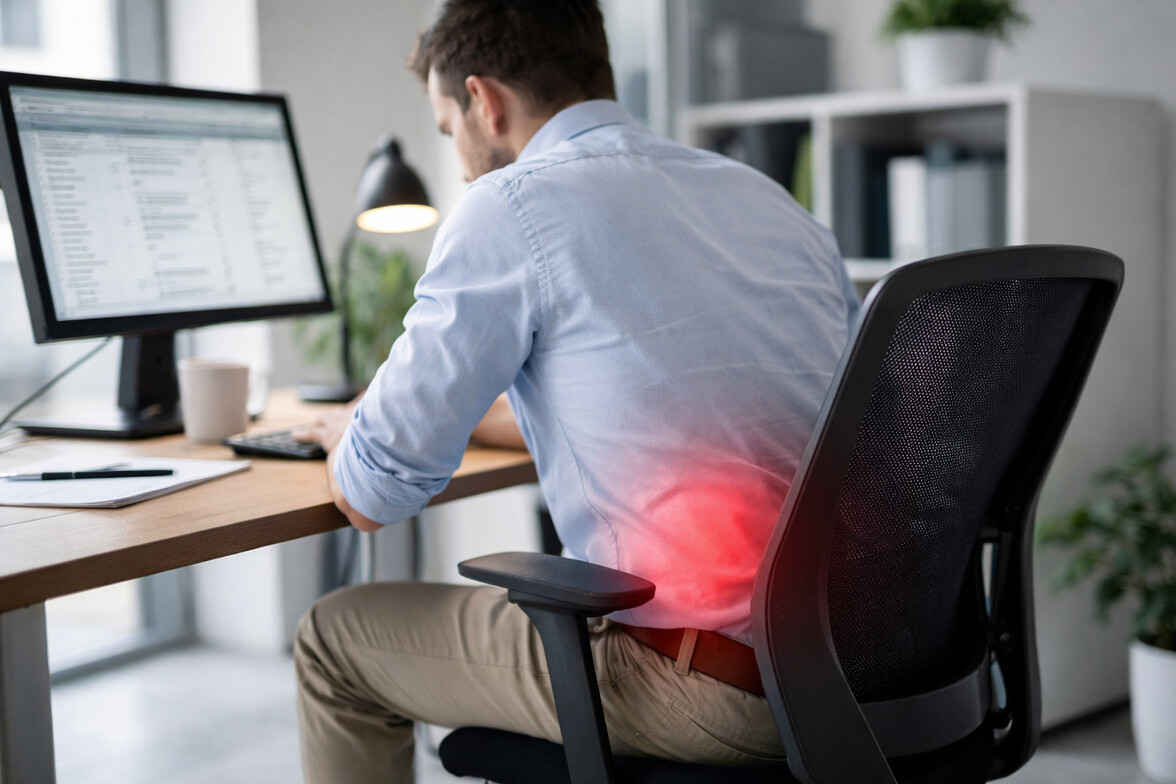
Low back pain while sitting is one of the most common complaints I hear as a chiropractor in Olathe. Many patients tell me they feel relatively fine when standing or walking, but the moment they sit down at work, in the car, or on the couch, discomfort builds in their lower back. This pattern is often connected to how sitting loads the spine and commonly overlaps with broader low back pain patterns that develop gradually rather than from a single injury.
Sitting places sustained pressure on the lumbar discs and joints while limiting normal spinal movement. Compared to standing, seated posture increases compressive forces through the lower back, especially when sitting for long periods without changing position. Over time, this can make the area feel stiff, achy, or compressed even without sharp pain.
When you sit, your hips flex and the pelvis often rolls backward, which can flatten the natural curve of the lumbar spine. This shift transfers load to the spinal discs, small stabilizing joints, surrounding ligaments, and postural muscles. Because sitting is static, these tissues stay under continuous stress instead of cycling through movement and recovery. As the duration increases, the lower back may become more sensitive, particularly in people already dealing with underlying disc pain or irritation that hasn’t fully resolved.
Patients commonly describe a dull ache across the lower back, stiffness when standing up after sitting, a deep pressure sensation, tightness spreading into the hips or glutes, discomfort that worsens as the day goes on, soreness after driving, difficulty finding a comfortable seated position, or relief that comes briefly when standing or walking. Some notice symptoms that stay localized, while others describe vague spreading sensations that don’t follow a clear pattern. These descriptions help explain why sitting can feel uniquely aggravating without pointing to a specific diagnosis.
In the office, I frequently see movement-based patterns where patients tolerate standing better than sitting, or where pain builds slowly the longer they remain seated. Many report stiffness during the transition from sitting to standing, discomfort late in the workday, or symptoms that fluctuate depending on posture rather than activity level. Some notice that prolonged sitting aggravates symptoms associated with sciatica, while others feel localized low back tightness without leg symptoms. These observable patterns guide care decisions without assuming all low back pain behaves the same way.
Chiropractic care focuses on improving spinal motion and reducing abnormal mechanical stress rather than masking symptoms. Chiropractic adjustments help restore normal joint movement so the spine is not stuck under constant load. Spinal and vertebral decompression may help reduce sustained pressure on spinal discs that are stressed during prolonged sitting. Hydromassage helps relax muscles that tighten during static postures, while cupping therapy can support local tissue mobility and circulation in chronically restricted areas. Structured exercise and stretch routines help improve endurance and stability so sitting becomes more tolerable over time.
At Woodroof Chiropractic & Acupuncture, care is individualized based on how your body responds to sitting, standing, and movement throughout the day. Rather than assuming all pain has the same cause, we look at mechanical patterns, posture tolerance, and daily stressors to guide care. Modalities are combined thoughtfully to support spinal function and long-term resilience. Most patients begin noticing improvement within the first few visits.
People often ask whether sitting all day can cause back pain, why their lower back feels worse after driving, or why stiffness shows up when standing after sitting. Others wonder if posture alone is the problem or whether movement breaks really help. In many cases, small changes in movement habits combined with appropriate care make a noticeable difference without aggressive interventions.
If you’re dealing with low back pain while sitting, we can help. Call our Olathe chiropractic office at 913-735-6351, or click Schedule Your Visit to get started. We also work with many insurance plans, which you can review on our insurance page.
Ike Woodroof
Contact Me