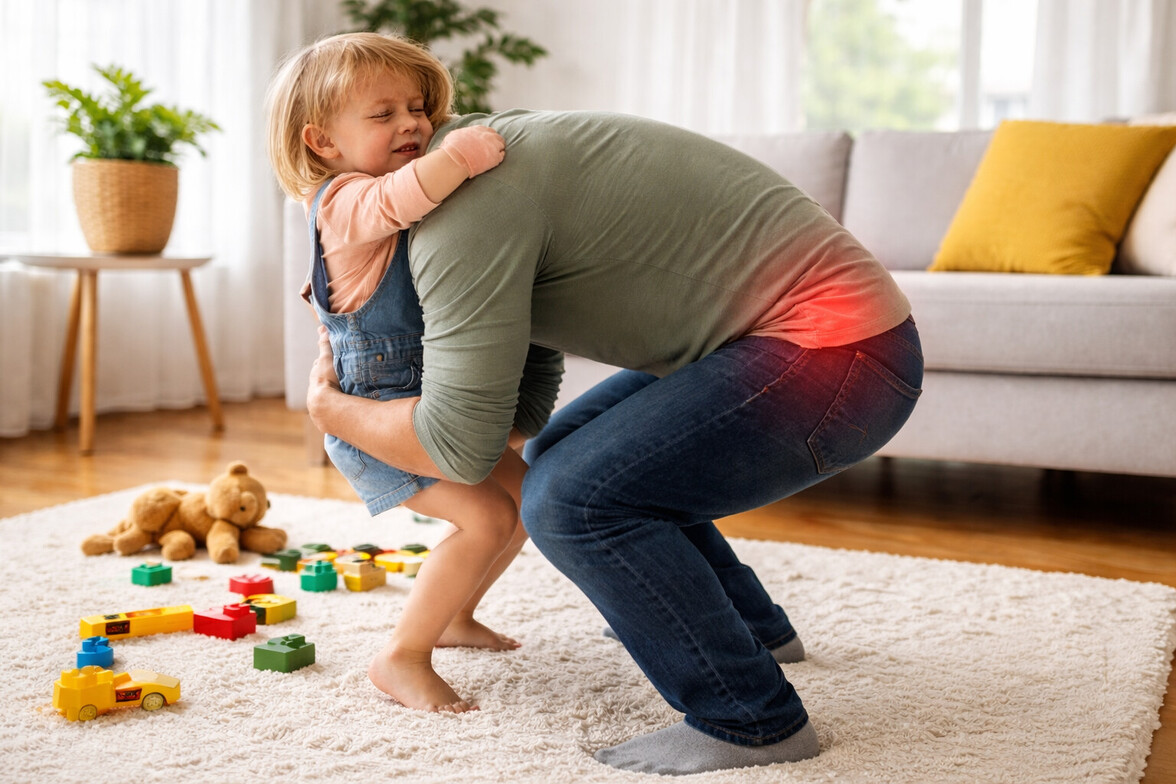
If you’ve ever finished playing on the floor with your kids and stood up thinking, “Why does my back hurt so much?” — you’re not alone. As a chiropractor in Olathe, this is something I hear every week from parents who otherwise feel healthy and active. The bending, twisting, lifting, and awkward positions that come with parenting can place significant stress on the spine. If this turns into persistent discomfort, you can learn more about how we approach spinal stress and mechanical irritation on our low back pain page here.
Why does playing with kids cause back pain?
Repeated bending, lifting, and rotational movements increase compressive and shear forces through the lumbar spine. When this is done frequently — especially from the floor — the joints, discs, and supporting muscles can become irritated and fatigued.
Most parents don’t think of playtime as “lifting,” but it absolutely is. Picking up a 25–40 pound child from the ground repeatedly, leaning forward while pushing toy cars, twisting while carrying them on one hip, or crouching without proper support places load through the lumbar discs and facet joints. Over time, muscles fatigue and begin to lose their ability to stabilize the spine efficiently. When that happens, even simple movements like standing up from the floor can feel sharp, tight, or stiff.
Common symptoms parents describe include:
• Tightness across the beltline
• Sharp pain when first standing up
• Difficulty straightening fully upright
• A pulling sensation on one side of the low back
• Pain after sitting on the floor
• Discomfort when carrying a child on one hip
• Stiffness first thing the next morning
• Soreness that improves with light movement
• A dull ache that builds by evening
• Occasional pain into the upper glute area
In the office, I often see predictable mechanical patterns. Many parents tolerate walking fine but struggle with prolonged floor sitting. Others feel better once they get moving but flare up after repeated lifting. Some report one-sided tightness from always carrying a child on the same hip. These are typically load-management and movement issues — not something that suddenly “went out.”
Another factor is duration. Play sessions often last longer than we realize. Ten to twenty minutes of forward-flexed posture repeatedly throughout the day can accumulate stress quickly. Combine that with work-related sitting, and the lumbar spine never truly gets a break.
Parents sometimes ask:
Is this a slipped disc?
Most of the time, occasional soreness after play is related to mechanical strain and joint irritation. Persistent or radiating symptoms should be evaluated further.
Why does it hurt more when I stand up?
After sustained flexed posture, the posterior joints and tissues are compressed. Transitioning to upright can temporarily increase tension in those irritated structures.
Should I stop playing with my kids?
Not at all. The goal is improving movement mechanics, strengthening support muscles, and restoring normal joint motion.
Is this just part of getting older?
Age can influence recovery, but movement quality and load management matter more than the number on your birthday.
When should I get checked?
If pain lingers beyond a few days, keeps returning, or begins to limit activity, it’s reasonable to have it evaluated.
Chiropractic care focuses on restoring motion to restricted joints, improving spinal mechanics, and reducing irritation from repetitive stress. When movement improves, tissues tolerate activity better — including wrestling on the living room floor.
If you’re dealing with back pain after playing with your kids, we can help. Call our Olathe chiropractic office at 913-735-6351 or click “Schedule Your Visit” to get started.
Ike Woodroof
Contact Me