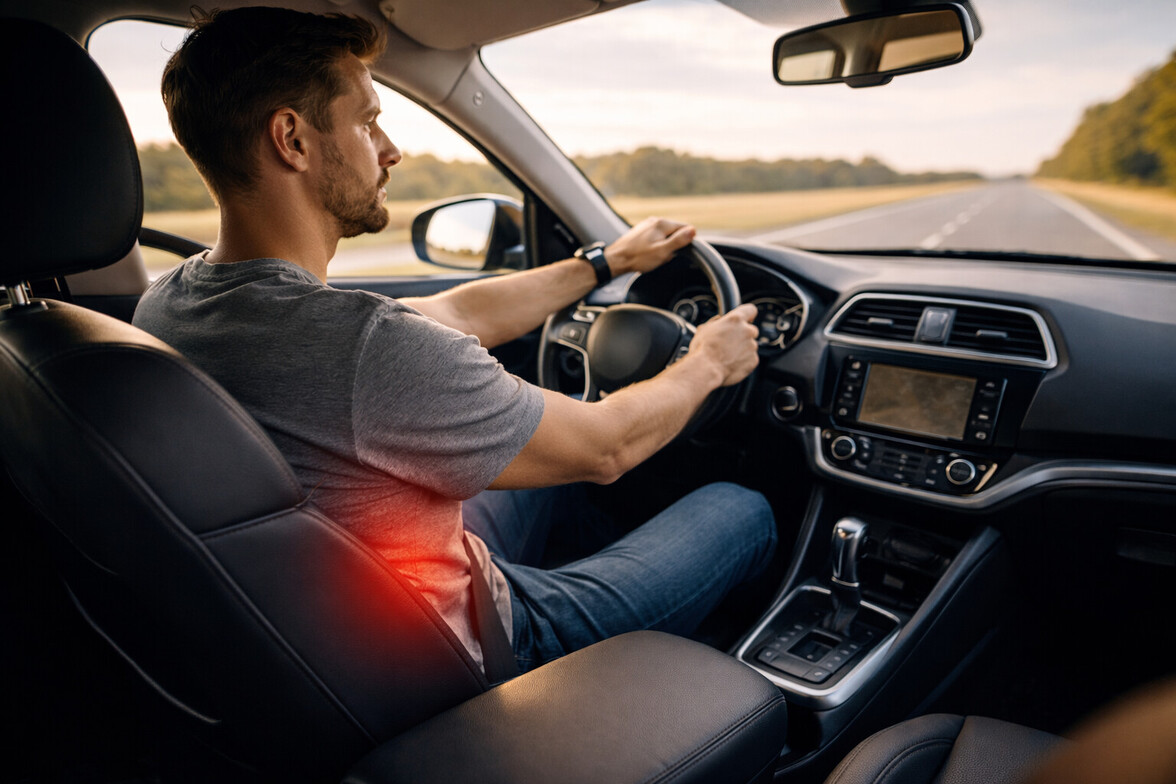
If you’ve ever stepped out of your car after a long drive and felt stiff, sore, or locked up in your lower back, you’re not alone. Many patients tell me their low back pain doesn’t show up during the trip — it hits when they stand up after hours of sitting. As a chiropractor in Olathe, this is one of the most common travel-related complaints I hear. If you want a full breakdown of structural causes and long-term patterns, visit our main page on low back pain for a deeper explanation of how spinal joints and discs contribute to ongoing discomfort.
Why does low back pain happen after long road trips?
Prolonged sitting increases compressive forces on the lumbar discs while reducing movement in the spinal joints. Over time, muscles fatigue, joints stiffen, and pressure builds in the lower segments of the spine.
When you sit in a car seat for extended periods, several things happen simultaneously. Your hips remain flexed. Your pelvis subtly tucks under. Your lumbar curve flattens. The small stabilizing muscles of your spine reduce activation. Meanwhile, the intervertebral discs experience sustained compression. Unlike walking or standing — where movement distributes load — sitting creates constant pressure without motion.
Car seats also tend to push your shoulders forward. That forward reach to the steering wheel increases thoracic flexion, which transfers additional stress downward into the lumbar spine. Over hours, this becomes cumulative mechanical strain.
Here are common patterns patients report after long drives:
• Stiffness when first standing up
• A dull ache across the beltline
• Sharp pain when straightening fully upright
• Pain that improves briefly with walking
• One-sided low back tightness
• Pain when bending forward to unload luggage
• Difficulty twisting to exit the car
• Aching into the upper glute region
• Occasional pain traveling into the hip
• Increased discomfort later that evening
In some cases, prolonged sitting may irritate disc tissue. If symptoms begin traveling into the leg, tingling develops, or pain persists beyond typical stiffness, we evaluate those patterns further. Our page on disc bulge explains how disc pressure patterns differ from simple muscular fatigue. If symptoms extend down the leg, you can also review how sciatica behaves and how it differs from localized low back discomfort.
In the office, I often see predictable movement patterns after road trips. Patients frequently tolerate sitting during the drive but feel worse with extension when they stand. Others feel tight bending forward. Some improve once they move around for 10–15 minutes. The key distinction is whether the pain behaves mechanically (movement-dependent) or progressively worsens regardless of position.
Extended driving creates what we call “static load intolerance.” The spine thrives on motion. It does not thrive on prolonged stillness under compression.
Common Questions
How long is too long to sit while driving?
Most people begin experiencing increased spinal compression after 45–60 minutes without movement. Brief walking breaks reduce cumulative load.
Why does my back hurt more when I stand up than when I’m sitting?
When you stand, spinal joints re-engage and compressed tissues begin moving again. That transition can temporarily trigger discomfort.
Can car seats cause disc problems?
Car seats themselves don’t cause structural damage, but prolonged flexed posture can increase pressure on already sensitive disc tissue.
Should I stretch before or after a long drive?
Both can help. Gentle lumbar extension and hip mobility exercises before and after driving often reduce stiffness.
Is this just muscle tightness?
Sometimes. But persistent or radiating symptoms may involve joint or disc irritation, which behaves differently than simple muscle soreness.
If you’re dealing with low back pain after long drives, we can help. Call our Olathe chiropractic office at 913-735-6351 or click “Schedule Your Visit” to get started.
Ike Woodroof
Contact Me