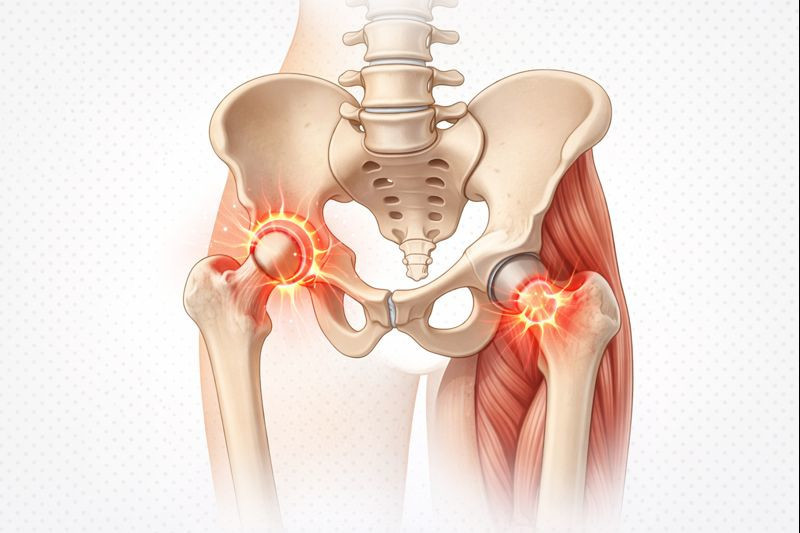
Have you ever been walking around your house, getting up from a chair, or taking a step and suddenly felt or heard your hips popping, clicking, or grinding? If you’re dealing with noisy hips, you’re not alone—and for many patients, this sensation can feel unsettling or even painful. As a chiropractor in Olathe, I see patients every week who worry that something is “out of place” or that joint damage is occurring. The good news is that hip clicking is usually related to how your joints, muscles, and movement patterns are functioning—and chiropractic care can help restore smooth, comfortable motion.
Why do hips pop or click?
In most cases, hip popping happens when tight muscles or tendons move over bony structures, or when joint motion is restricted and then suddenly releases during movement. This is often a mechanical issue rather than a serious injury.
Why this problem happens becomes clearer when you look at how the hip joint works. The hip is a ball-and-socket joint designed for stability and powerful movement, but it relies heavily on surrounding muscles, ligaments, and proper joint motion. When certain muscles—especially the hip flexors—become tight from prolonged sitting, poor posture, or repetitive activities, the tendons can snap over bony landmarks of the pelvis. Over time, this repetitive friction can lead to irritation and inflammation. Restricted joint motion in the pelvis or lower spine can also change how forces travel through the hip, increasing stress on discs, nerves, and surrounding soft tissues. Poor posture, long hours of sitting, limited mobility, and uneven movement patterns all contribute, especially when combined with activities like running, lifting, or sports. In some patients, nerve tension or disc-related issues from the lower spine can further alter hip mechanics, which is why hip symptoms often overlap with low back pain or sciatica.
Common symptoms patients notice vary from person to person but often follow recognizable patterns. Many patients describe a popping or clicking sensation when standing up after sitting, a snapping feeling in the front of the hip while walking, grinding during certain movements, stiffness first thing in the morning, aching in the groin or buttock, discomfort during workouts, pain after long drives, or tightness that radiates into the low back. Others report symptoms that worsen with prolonged sitting, improve briefly after moving, or flare up during exercise. It’s also common for hip issues to coexist with mid back pain, neck pain, or even headaches due to compensatory movement patterns throughout the spine.
Clinical patterns I see in the office help distinguish mechanical hip issues from more serious concerns. Many patients tell me their hip feels worse after sitting at a desk or driving for long periods, then briefly loosens up once they start moving. Others notice clicking during squats, lunges, or stair climbing. Athletes and runners often describe pain that builds gradually with activity rather than appearing suddenly. Some patients feel better after stretching or walking but worse again later in the day. These patterns point toward joint restriction, muscle imbalance, and movement dysfunction rather than structural damage—and they respond very well to conservative chiropractic care.
How chiropractic helps focuses on restoring proper motion and reducing unnecessary stress on the hip joint. Gentle chiropractic adjustments to the spine and pelvis help normalize joint mechanics and improve how forces move through the body. When needed, spinal decompression can reduce pressure on lumbar discs and nerves that influence hip movement and muscle tone. Hydromassage therapy helps relax tight muscles, improve circulation, and calm irritated tissues around the hips and low back. Targeted strengthening and mobility exercises—guided through our exercise and stretch routine—help retrain the hip to move smoothly and reduce future clicking.
Our treatment approach at Woodroof Chiropractic is always individualized. Care typically includes chiropractic adjustments to restore joint motion, spinal decompression when disc or nerve stress is involved, hydromassage to ease muscle tension, targeted strengthening to support hip stability, specific stretching routines to reduce tightness, corrective exercises to improve movement patterns, and posture and sleep coaching to prevent recurring strain. We also help patients understand activity modification so they can stay active without aggravating their symptoms. Most patients begin noticing improvement within the first few visits.
Frequently asked questions include: Why does my hip click more after sitting? Prolonged sitting tightens hip flexors and limits joint motion, making popping more noticeable when you stand. Should I see a chiropractor for popping hips? Yes—especially if clicking is accompanied by pain, stiffness, or limited movement, a chiropractor can address the underlying mechanics. When is hip popping serious? If popping is associated with sharp pain, instability, or loss of strength, further evaluation is warranted. How long until I feel better? Many patients experience relief within a few visits, though long-standing issues may require a structured care plan. Will insurance cover treatment? Coverage varies, but our office is happy to help you understand your benefits through our insurance options.
If you’re dealing with popping or clicking hip pain, we can help. Call our Olathe chiropractic office today at 913-735-6351 or click Schedule Your Visit to get started.
Ike Woodroof
Contact Me