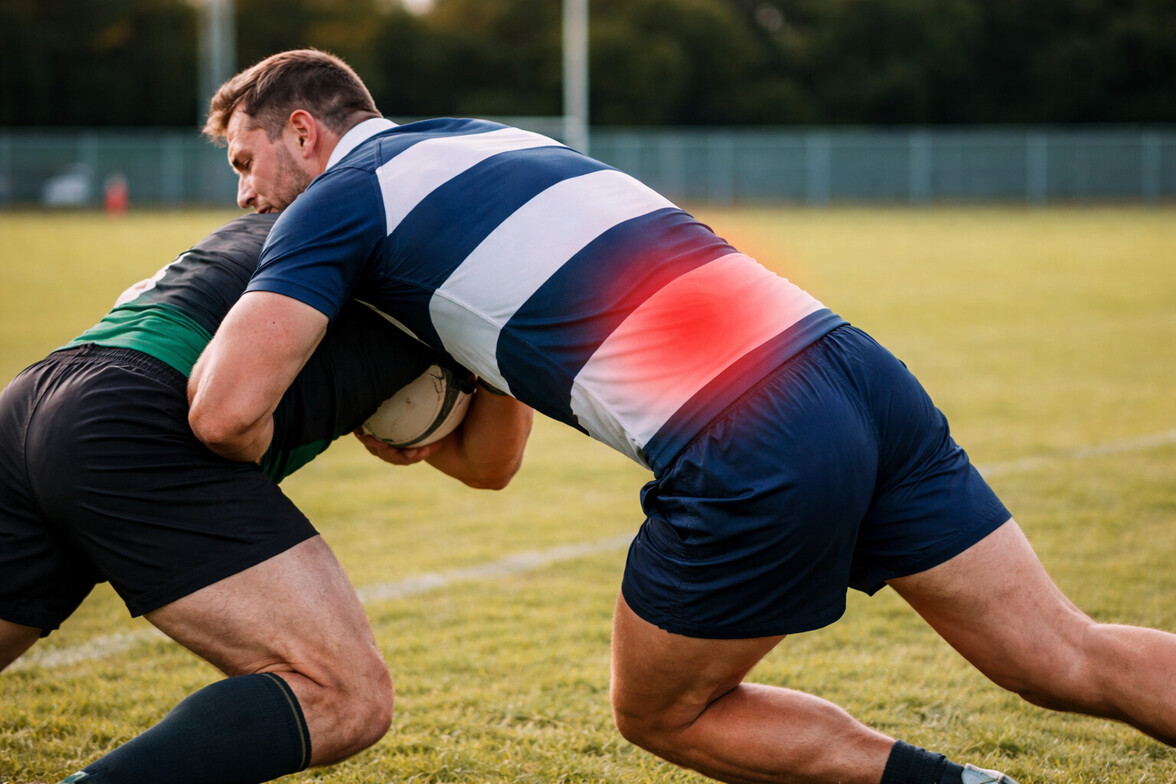
Anatomical illustration of the sacroiliac (SI) joints showing inflammation and irritation in the lower back and pelvis.

At Woodroof Chiropractic & Acupuncture in Olathe, many of our patients come to us with pain that has been lingering for years, especially after old sports injuries. One of our recent success stories is Benjamin, who suffered a rugby injury back in 2016 that left him with chronic low back and SI joint pain. After trying multiple providers without long-term relief, he came to our Olathe chiropractic office looking for a solution that would finally help him move, work, and sleep without constant pain.

Featured snippet–style explanation: Chronic low back and SI joint pain after a rugby injury often comes from stress on the L5-S1 disc, the surrounding facet joints, and the sacroiliac (SI) joint. Over time, that stress can cause degenerative disc changes, joint irritation, and nerve sensitivity that make even simple activities like bending, sitting, or standing feel painful.

Why this problem happens after a rugby injury:
Rugby is a high-impact, high-contact sport. Sudden collisions, awkward tackles, and repetitive bending or twisting place heavy load on the lumbar spine and SI joints. When that force is concentrated at one level, often L5-S1, it can lead to disc irritation, early degenerative changes, and chronic inflammation around the joints. In Benjamin’s case, his injury from 2016 never fully resolved. Over the years, his pain slowly worsened, spreading from the low back into the SI joint and occasionally into the leg. By the time he came into our office, his pain was 9/10 with movement and interfering with his work, sleep, and basic daily activities.

The lumbar discs act like cushions between the vertebrae. When they are overloaded or repeatedly stressed, microscopic tears can form in the outer disc fibers. This allows the disc material to bulge, irritating nearby nerves and pain-sensitive structures. At the same time, the SI joint can become inflamed and stiff, especially in athletes who have taken direct impact to the pelvis or repeatedly twisted while being tackled. When you add in muscle guarding and poor movement patterns from years of “protecting” the painful area, the entire low back and pelvic region can become hypersensitive.

Common symptoms patients like Benjamin notice:
Patients with chronic low back and SI joint pain from an old sports injury often describe sharp or aching pain across the beltline of the low back, pain that spreads into one or both SI joints near the dimples at the base of the spine, stiffness and pain when first getting out of bed or standing up from a chair, pain that increases with bending, lifting, or twisting, discomfort or burning pain into the buttock or back of the leg, difficulty sitting through a workday or long drive, pain that flares after activity, and tenderness to touch over the L5-S1 area or SI joints.

Many patients like Benjamin have already tried different providers before they see us, including other chiropractors, physical therapy, injections, or pain medications. They often feel stuck between “just living with it” and more invasive options.

Clinical patterns we see in the office:
Benjamin’s case mirrored many of the patterns we regularly see in Olathe athletes and active adults with chronic low back pain. His pain started after a clear injury, in his case a rugby hit in 2016. The pain gradually worsened over the years. It increased with bending forward, lifting, or sitting too long. Standing still for very long was uncomfortable, and previous treatments only brought temporary relief.

During his exam, we performed a detailed history, orthopedic testing, neurological screening, and palpation of the lumbar spine and SI joints. X-rays confirmed degenerative changes at L5-S1 and mechanical stress across the SI joint, helping us better understand why his pain had become so persistent.

How chiropractic helps in cases like this:
For patients like Benjamin, our goal is not just short-term relief. We focus on restoring motion, reducing pressure on irritated discs and joints, and rebuilding stability. At our Olathe clinic, we use a combination of gentle chiropractic care, non-invasive spinal decompression, hydromassage therapy, and a structured exercise and stretch routine to treat each layer of the problem.

Chiropractic adjustments help restore normal motion to the lumbar and SI joints. Spinal decompression gently unloads the L5-S1 disc, helping reduce irritation and improve disc health. Hydromassage relaxes tight muscles and improves circulation, making movement easier and more comfortable. Targeted home exercises build stability so the spine and pelvis stay supported during everyday activities.

Benjamin’s treatment plan at Woodroof Chiropractic:
His customized plan included chiropractic adjustments to L5-S1 and the SI joint, spinal decompression focused on the L5-S1 disc, hydromassage for muscle relaxation and circulation, intersegmental traction for gentle spinal mobilization, and a targeted home exercise program for core control and hip stability.

Within a few visits, Benjamin began experiencing meaningful relief. On his first visit, his pain was 8 to 9 out of 10 with basic movement. By visit three, his pain reduced to around 4 out of 10. By visit seven to eight, his pain was around 3 out of 10 with better mobility, less guarding, and improved confidence.

As his pain decreased, we spaced out his visits and transitioned him into a maintenance plan. Most importantly, he regained the ability to bend, stand, and move without constantly anticipating pain.

How this applies to other low back and SI joint pain sufferers in Olathe:
Benjamin’s case is a strong example of how a structured chiropractic approach can help athletes and active adults recover years after an injury. If you’re dealing with similar symptoms, you may benefit from the same tools he did: chiropractic adjustments, spinal decompression therapy, hydromassage, and a guided exercise routine. You can also explore related conditions on our low back pain page, disc bulge page, and sciatica page.

Frequently asked questions:

Is it normal to still hurt years after a rugby injury?
Yes. If the original injury stressed the disc, joints, or SI region and never fully recovered, irritation can persist for years. The good news is that meaningful improvement is still possible with the right plan.

How do I know if my pain is disc-related or from the SI joint?
A full exam including orthopedic, neurological, and movement testing helps us determine the primary source of your pain.

Can chiropractic and decompression help if other treatments haven’t worked?
Yes. Many patients improve with a combined approach that treats both the joints and discs while improving stability through exercise and neuromuscular retraining.

Will I need to stop sports or workouts?
Usually not. We typically modify painful movements, then gradually reintroduce activity as your spine and SI joint calm down and become more stable.

Does insurance cover this?
Many insurance plans do offer coverage for chiropractic care. You can learn more about your options on our insurance page.


If you’re dealing with chronic low back or SI joint pain after a sports injury, we can help. Call our Olathe chiropractic office today at 913-735-6351 or click “Schedule Your Visit” to get started.


Dr. Ike Woodroof

Dr. Ike Woodroof

Contact Me